Monday, April 15, 2013

Annette's Post on Southern Kosovo - Grancanica Monastery and Novo Brdo

On our drive to Serbia, we left Pristina and made two stops.  The first stop was to visit the Serbian Orthodox monastery in Gracanica.  The second stop was about 30 minutes away - the ruins of the medieval castle in Novo Brdo. 


The Serb village of Gracanica  is just outside of the Kosovo capital, Pristina, and is home to about 13,000 Kosovo Serbs. The Serbian government funds services in the village including health centers and university faculties linked to the Serb-language university in Metrovica offering distance learning.  Serb government facilities also issue passports, birth certificates, and business registration. This is a small Serbian Orthodox chapel much like those we saw in Slovenia and Croatia (except for the architecture).  The chapel is right in the town center.


A photo of what was inside of the chapel - small icons, flowers, and photos of presumably deceased loved ones.


The green market in Gracanica.  The small village was lively with lots of people walking around.  The road from Pristina to Skopje, Macedonia goes right through the center of town and past the monastery.


A Serbian babushka rolling her wheelbarrow filled with produce to the green market.  You can also see the Pristina-Skopje road that goes through town.


A view of the monastery from the entrance.   Inside of the grounds, there were nuns all around.  There was also a gift shop where I bought a couple of small icons and some plum brandy made by the Serbian monks.  They were also selling rosaries made of wool.  The rosaries had 100 beads and no decades.  The monastery is considered to be one of the finest examples of late Byzantine architecture and contains some of the best-preserved 14th century frescoes. The monastery church was funded by Serbian King Milutin.  During his reign (1284-1321), the Serbian kingdom extended to the Adriatic coast, and Skopje (now Macedonia) was its capital.


The well-preserved frescoes inside of the church were the works of a team of painters assembled by King Milutin.


One of the several altars with icons inside of the church.


Another altar with frescoes and icons.


The monastery church had 4 domes and each of those areas had an altar.


The ceilings of the domes were painted with images of God, Jesus, and saints.


Another ceiling painting with frescoes on the walls.


On our way to Serbiaafter leaving Gracanica, we went off of the main road to visit Novo Brdo which was at one time the largest city in Kosovo.  In medieval times, the town had a population of over 40,000 people.  The town's importance came from the silver mine in the area, and this is a photo of a mining area, but there are no active mines today.


A view of the castle at Novo Brdo.  The castle was built in the 13th century. In the middle of the 15th century, Turks took over the town and continued the mining.  Because of the importance of the silver mines, Novo Brdo was granted special exemption from some of the Ottoman taxes and rules, and most of the town remained Christian throughout the Ottoman rule.


Frank waving near the top of the hill inside of the castle fortification.


This is all that is left of the castle, and it was too difficult to climb inside of the area where the castle interior existed.  We were the only tourists at the site.  There were a few workmen building a retaining wall at the bottom of the hill but no other people.  We walked to the top and then around the perimeter of the castle walls.


One side of the castle ruins with a cross designed on the flat wall..


The view from the castle was beautiful.


Another view from the castle - you can see a small lookout in the center of the photo.  About a mile from the castle, there is a parking area, and a visitors' area is being built along with a well-designed pathway leading from the parking area to the castle hill.  So far, the pathway goes only to the bottom of the hill.

Friday, April 12, 2013

Annette's Post about Driving in Southern Kosovo

As Frank posted last week, we rented a car for 10 days in Skopje, Macedonia.  It is problematic to rent cars in Kosovo - many rental agencies don't allow you to take cars into Kosovo or charge extra fees for doing so.  Some Fullbright friends in Pristina had rented a car over the Christmas holidays in Skopje, so we got the information from them and rented a nice little Fiat that we could take into any surrounding countries for just 35 Euros extra.  

We wanted to visit another English Language Fellow who is living in Nis, Serbia since we had the car, so we planned a trip for the long weekend.  (I don't have any classes or regular work on Fridays and Mondays, so I always have 4-day weekends; this week, Tuesday was Europe Day, and Kosovo also celebrated that, so  my classes were cancelled.)  I had a luncheon at the American Embassy in Pristina on Friday afternoon, so we spent the night in Pristina and headed off for Serbia the next morning. 


The drive should have only been 4 or 5 hours, but took much longer.  This post  and most of the photos involve all of the road hazards we had to deal with within the span of about 3 hours in Southern Kosovo.  Looking back, it is kind of funny, and we did laugh at times during the trip; we also got very frustrated at times.  Above, you can see a common vehicle in Kosovo.  It is a cart with a motor like a lawnmower motor.  In Prizren, we see these all of the time - usually operated by farmers or cut wood providers who are bringing their produce or wood from villages to Prizren to sell.  When you get behind one of these things, the traffic moves at a snail's pace.


We see signs like the one above often on highways or main streets in Kosovo.  We're not sure what the sign means.  With KFOR troops still stationed throughout Kosovo, I guess the sign referring to tanks isn't that surprising.  If anyone can interpret this sign, we would appreciate a translation!


After leaving Pristina, we eventually had to drive through one of the other major towns in Kosovo - Gjilane.  Driving in cities is problematic because in a major town, there might be only one or two stoplights.  Some major intersections might have a roundabout for controlling traffic(where you basically have to play chicken with the other drivers), but usually, as seen above, it is every man (or woman) for himself.  It took us about an hour just to drive through Gjilane, and many of the streets were narrow with cars, pedestrians, and other obstacles everywhere.


This is an example of "other obstacles" that I was talking about even though this was outside of Gjilane on the way to the Serbian border.


Yet another lawnmower-motorized cart - this one coming towards us!


You have to watch out for the sheep, too!


And don't forget the poor chickens!  In one place on this afternoon, there were actually a few chickens who passed in front of our car.


We were glad that the horse and cart were approaching us and not right in front of us, slowing down traffic!
After driving through Gjilane and trying to cross the Serbian border within about 30 minutes of Gjilane, we were turned away by the border officials. Serbia does not recognize Kosovo as a separate country, and if you try to enter Serbia from Kosovo without having a stamp in your passport indicating that you already had legally entered Serbia, the officials accuse you of being in Serbia illegally and turn you away.  We had heard that this problem had been solved at the end of last year, and that we could enter Serbia even though we didn't have an entry stamp in our passports.  We we wrong.  The Serbian border guards were very unfriendly and sternly told us that we had to turn around and go back.  Unfortunately, this added an additional 4 or 5 hours to our trip because we had to go into Macedonia and then enter Serbia from there.  Here is a link to a map of the area if you want to see how we were traveling from Pristina, Kosovo to Nis, Serbia:
http://www.collinsmaps.com/maps/Kosovo/216318C.aspx


On our way to Macedonia, we had to backtrack.  Due to non-existent road signage, we didn't realize that we missed the entrance to the main road going south to Macedonia when we got near another big Kosovo town, Ferizaj.  Unfortunately, we wasted another 30 minutes or so navigating through the town.  Once you're in a Kosovo town, it takes a while to get out since there are few roads that go through the entire town, so you just have to persevere and keep on driving. Most roads  navigate in an indirect way through the town.   As you can see, a driver not only has to worry about cars coming from all directions, but also there are pedestrians and bicyclists added to the mix.  Here, a guy with a cart full of potatoes walked in front of us.  In one tight spot with cars all around and only a small space between us and the car in front of us, a bicyclist came out of nowhere and sneaked between us and the car in front - luckily, Frank was totally stopped and not getting ready to accelerate.  Pedestrians are a big concern for drivers because often the streets are narrow, and since there is no parking, cars go up on the curb and park on the sidewalk. Pedestrians are often forced to walk in the street because cars are all over the sidewalk, or sometimes the sidewalk just disappears because it is on an old narrow alleyway where there is no room for the sidewalk in places.


More pedestrians in Gjilane.


I'll end this post with a few photos that capture the religious diversity in Kosovo. Here is a mosque in Gjilane.


This is a Serbian Orthodox church outside of Gjilane.


Another church in the Kosovo countryside as we drove towards Macedonia.  I will post more photos of our trip over this weekend.  We spent two nights in Nis, Serbia and then one night in Skopje where Frank was very happy to return the car and get on a bus back to Prizren.

Wednesday, April 3, 2013


I've seen a few interesting signs while we have been here, so thought I'd share a few with you.  As you can probably tell, we are eating quite well here and my "shrinking" pants are a good indication of my lack of will power when it comes to good, cheap food.  But even with my expanding waistline I would be a bit reluctant to patronize these businesses:
This is Fast Food Fati on Bill Clinton Blvd. in Prishtina.  Might not be a good name for a fast food joint in the US.  After a few meals there I would probably have to buy my new clothes at this place we saw in Struga, Macedonia.  On our drive back to Kosovo from Ohrid we passed a place called XXL Cafe, but passed it too quickly to snap a picture. 
Since we have been in Kosovo we have occasionally craved "ethnic" food that does not include qebaps, pleskavice, ayvar or other Albanian specialties.  We have tried the Thai, Indian and Mexican restaurants in "cosmopolitan" Prishtina and I got all excited when I spotted the sign below in the capital city:
However, on closer inspection I realized that it was a photocopy store and not a Vietnamese restaurant called Pho Toc Opy where we could get a hot bowl of our favorite beef pho soup.  Darn!!!

Since I'm showing some signs, I'll show a few more of some of our regular stops in Prizren to give you a little feel for our normal daily life.
Annette stopping to buy some roasted pumpkin seeds at the Tetova nut shop.  They have all sorts of seeds and nuts and snacks that you can buy hot for about one euro for a small bag.
A recent warm sunny weekend day brought out nearly every resident of Prizren to the Shadervan plaza area, but we were still able to find a table and enjoy some coffee and a little snack at our favorite embeltorja along the river.
A couple blocks from our apartment are 3 places I frequent on a regular basis.  They are very close to each other so they serve as my "7-11" convenience store for quick shopping trips.
This is my go-to place for meat, where I can pick up a kilo of "mish" for 6 euros and have my mish-man grind if for me while I wait.  Nothing better than a burger that was a big hunk of meat a few minutes before.
If there is a butcher you gotta have a baker, so here is the "furra" where I get a loaf of fresh-baked whole wheat bread, which the call black bread, for half a euro.  They don't speak English but they bake good bread.  They were apparently getting a load of firewood the day I took this photo.
Across the street from the Ralin Furra is the place I run to for the onion or carrot I need to complete a recipe or to get a bottle of mineral water or some bananas for Annette.  Not a big selection but nice fresh fruits and veggies.
This is a fancy dress store directly below our apartment in Prizren.  Kosovo is a poor country but you would never know it by all the dress shops along our street.  Weddings and other parties are a time to show off, so you can find an endless selection of sparkly dresses and jewelry in the shops along Adem Jashari Street below us.  I'm trying to talk Annette into buying a fancy sparkly dress before we leave Kosovo, but no luck so far.


Tuesday, April 2, 2013

On the road again!

We decided to hit the road again, so last Friday we took a bus to Skopje, Macedonia and rented a car for 10 days.  After picking up our little gray Fiat at a shopping mall near the bus station we headed west and ended up in Tetovo, a town of about 50,000 located on the edge of the Sar Mountains.  As the crow flies, Tetovo is only about 16 miles from Prizren, but it took us two bus rides and an hour long drive to get there due to the high mountains between the two towns.  I was quickly introduced to the horrors of driving in this part of the world, having to avoid pedestrians in the dark streets, double parked cars everywhere, narrow one-way streets and traffic circles that are basically just games of chicken.  But we survived and found a hotel for the night and a place to park, so all was good.  The next morning we did a little touring in Tetovo before heading to Ohrid Lake.
This is the "Painted Mosque" in Tetovo, originally built in 1438.  It is unusual for the painted floral designs on the facade.  It does have a minaret on the other side - you can barely see the base of it at the top corner of the roof in this photo.

We soon left Tetovo and headed south toward the old town of Ohrid.  On the winding 2 lane road to Ohrid we saw two things we had never seen before.  First was a big stork nest, complete with a large stork that refused to pose for a good picture.
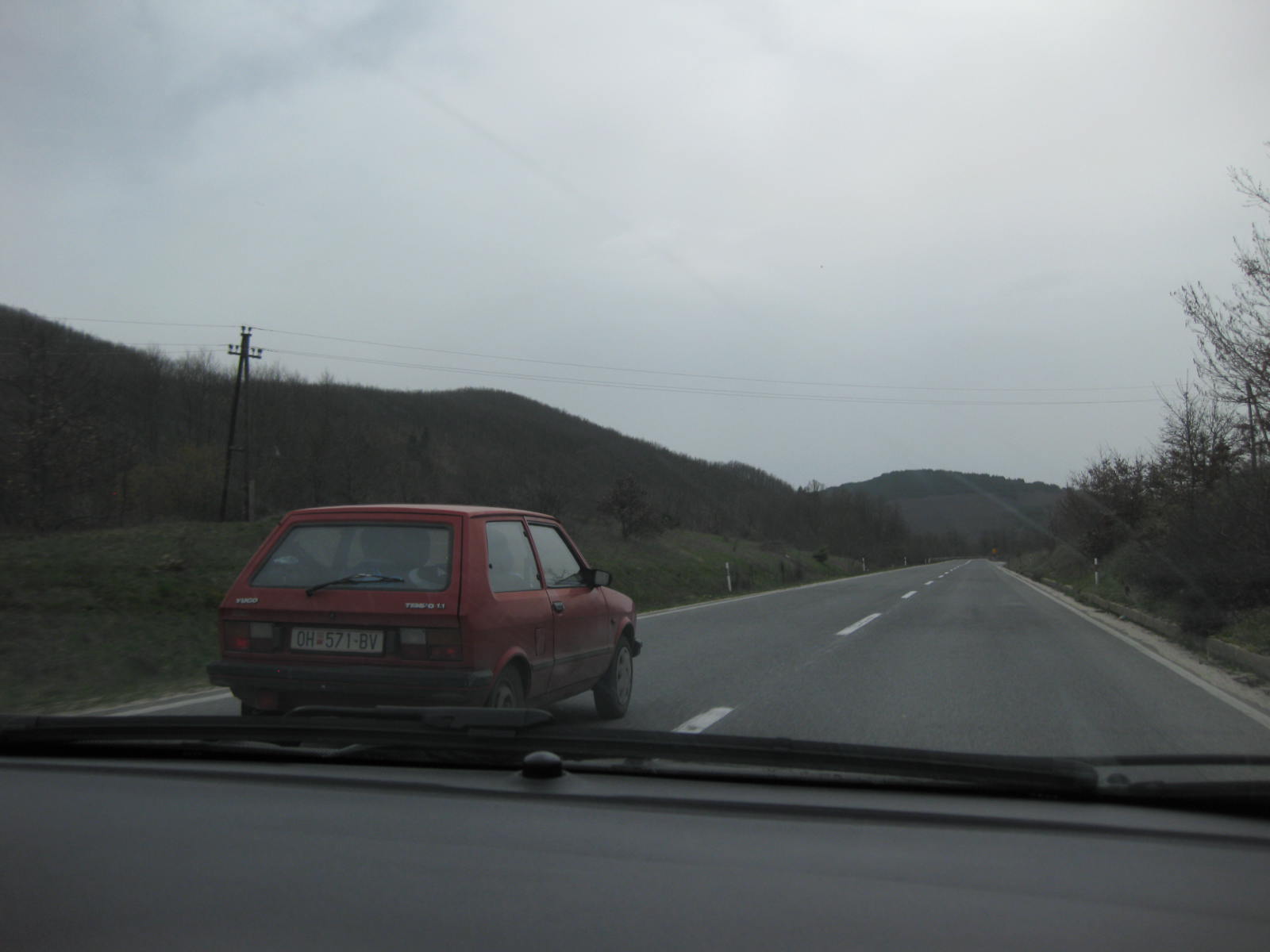
I'm almost embarrassed about the second thing, which was being passed by an old Yugo.
We occasionally see a Yugo in Prizren, but there were herds of them in Macedonia, and it looks like most of them are still roadworthy.  This one was moving pretty well on the downhill sections of the road, but I eventually regained my manhood and passed it on a long uphill stretch of road.
This is another common sight on the back roads of Macedonia, along with a lot of tractors and other farm equipment, since they are starting to plow and plant their fields since warmer weather is finally upon us.  A couple days later on the way back to Kosovo we passed a cart being pulled by a horse in full gallop - it was a fun thing to see!

Our first stop at Ohrid Lake was in the town of Struga, where the water from the natural lake flows out to form a river.  The lake is huge, about 30 kilometers long and 15 kilometers wide, and averages over 150 meters deep.  It is one of the oldest lakes in the world, estimated to have been formed by tectonic activity about 5 million years ago.  Due to its depth and the small amount of sediment flowing into it the water is extremely clear, and in Struga, where it flows into a man-made channel it has a beautiful blue color.
Annette had read about a traditional Macedonian restaurant in Struga, so we had to try it for lunch.  I had tavce gravce, beans baked in a clay pot, pretty much the national dish of Macedonia, and Annette ordered a stuffed pork dish.  After over a month in Kosovo it was nice to see pork on a menu again.  So, here is the food shot for this posting:
The pork roll was stuffed with cheese and mushrooms and other goodies and was quite tasty, as were my beans.  Some bread and a couple Skopsko beers completed a fine lunch.
Annette wanted to go to Macedonia over the Easter weekend so she could be in a predominantly Christian country, so here she is in front of the Roman Catholic church in Ohrid.  Although Ohrid was an important center of Roman Catholicism in the distant past, it is just starting to re-establish itself in Macedonia today.  This church complex appeared to be fairly new and the one Mass on Easter Sunday had no more than 50 people in attendance.  As you can see on this photo, it rained throughout much of our stay in Ohrid, but we were able to do some sightseeing during the breaks from the heavy rains.  We stayed 2 nights in a little apartment hosted by a cute older couple who greeted us with home-made brandy and juice and gave us some apples picked from their trees.  I had booked it on the internet and it was really hard to find, but at 22 euros a night it was a real bargain.
This is a view of Lake Ohrid.  The mountains to the left are in a Macedonian national park with peaks higher than 7000 feet.  The other side of the lake is in Albania.
We initially tried to get to the famous cliffside Church of St. John at Kaneo using the lakeside trail and boardwalk, but high water levels in the lake made that impossible.  However, we didn't discover that until after Annette had worked up the courage to walk across some parts of the boardwalk with major gaps between the wooden slats, so she got to do it twice!  But she was brave and did a good job!  We then had to take the land route up and down a few steep hills to get the this serene location.
The little Church of St. John at Kaneo is supposedly one of the most photographed buildings in the Balkans.  The land across the lake is part of Albania.
At the top of the hill is a newly built reconstruction of the Church of St. Clement, part of a large archeological site knows as Plaoshnik.  This was the site of a very early Christian basilica that has been partially excavated to show the detailed original mosaic floors and wall foundations.  It was also the site of one of the world's oldest universities, the Ohrid Literary School, founded by St. Clement in 886, which at one time had 3,500 students or disciples.  The school was dedicated to St. Paul, who preached in Ohrid in the 1st Century.
Part of the mosaic floor in the excavation of the old Christian basilica in the Plaoshnik.
This is a view up at Samuel's Fortress on the top of the hill in Ohrid.  We ran out of time to visit it due to the weather, but it surmounts the old walled city of Ohrid, which at one time had a 3 kilometer long protective wall surrounding it.  Portions of the wall and a few gates still exist, as shown below.
Ohrid is a town of about 50,000 population, but is a very popular summer vacation spot.  We were told there can be nearly that many tourists in town during July and August, so the town has many boutiques and shops on a large pedestrian-only street, shown in the photo below.  It would be nice to be there in warmer weather, but I don't know if I would like the crowds.  We enjoyed having the town pretty much to ourselves while we were there and we hope to make a return visit before we leave to explore the many places we missed this trip.
We returned to Prizren with the car, and are planning to do some more touring during her next 4 day weekend, which begins in less than 48 hours.  After walking around the narrow and confusing streets of Prizren for over 6 months is feels very strange to do some driving here.  I've decided I prefer going on foot a lot more than driving here, it is a whole lot less stressful.  That's it for now.