Sunday, March 3, 2013

Side Trip to Medjugorje
Leaving Makarska we continued to follow the scenic coastal road until we came to the town of Ploce and the delta of the Neretva River.  The valley of the river provides access through the coastal mountains into Bosnia & Hercegovina and is also a major agricultural region of Croatia.
 
We turned inland and followed the river a short distance until we came to the border crossing into Bosnia.  At the small passport check station shown below Annette got scolded by the guards for taking pictures, so we realized that things in Bosnia were probably a little different than in Croatia.

After several weeks without seeing any mosques or minarets we passed one at about the same time we started to see some high snow-capped mountains farther to the east near Mostar.  However, this part of the country is Hercegovina, which is more Christian than predominantly Muslim Bosnia, so churches were a more common sight than mosques in the little corner of the country that we visited.
After a short drive we arrived in Medjugorje.  As you may know, in 1981 the Virgin Mary "appeared" to 6 children on a hillside near the town, and continues to appear to 4 of the 6 who still live in the area.  Annette will probably do a blog entry with more information on the "apparition" story so I'll go on with the sightseeing part of the day.
This is the front of St. James Church, the epicenter of activities for the swarms of "pilgrims" who come to Medjugorje each day.
The outdoor altar at the back of the church - a huge venue.
They do confessions in a big way here.  This is one of two large groups of confessionals outside the church where they put little signs on the outside of each confessional booth to indicate the languages spoken by the priest inside.  
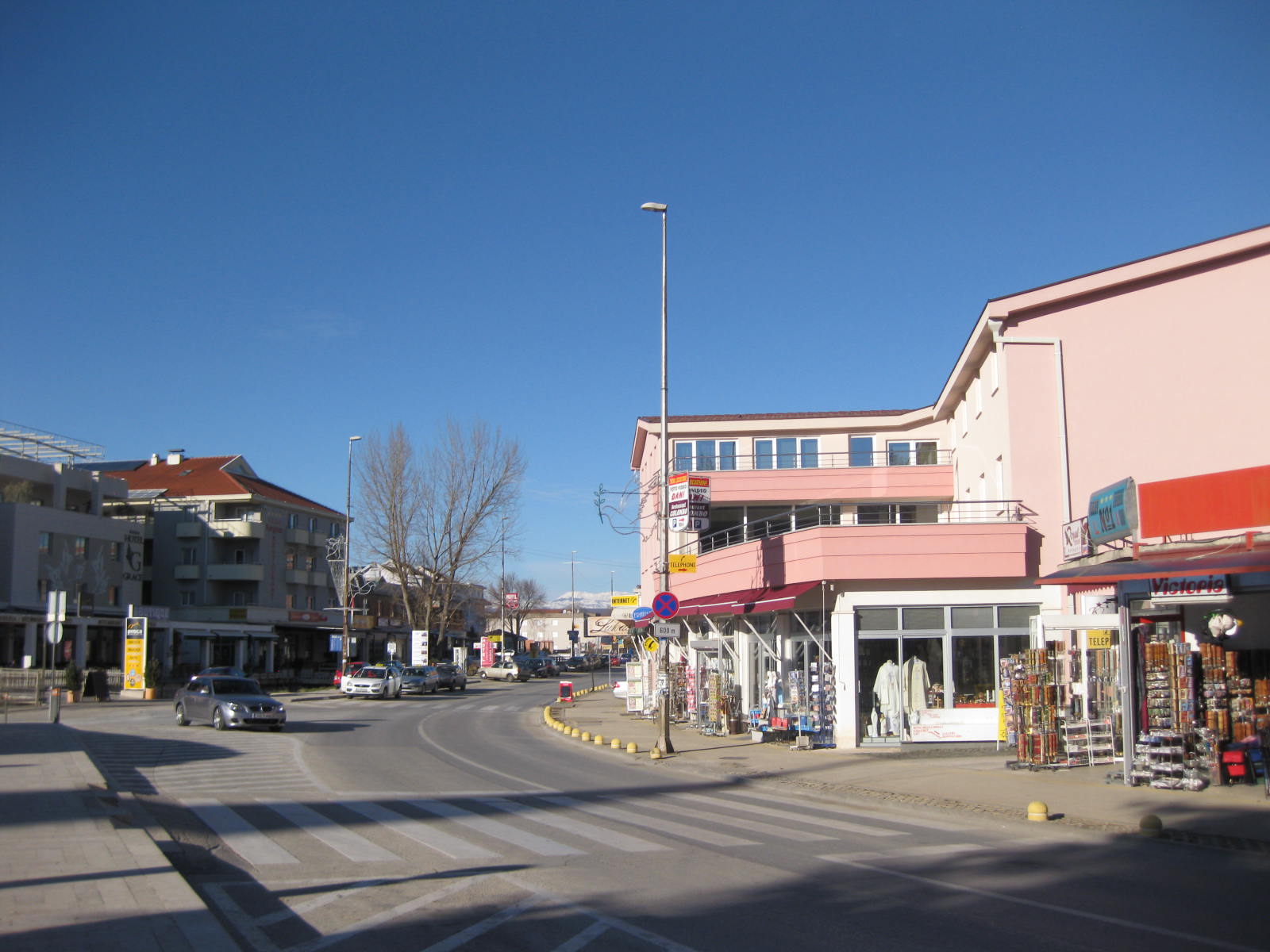
Behind the outdoor altar "stadium" is a large statue of Jesus on the cross, without the cross.  In the town are wall-to-wall gift shops where you can buy all the Medjugorje souvenirs you could ever want.  There must have been at least 50 similar shops near the church and other important "apparition" sites, selling rosaries, statues, t-shirts, etc.
 
We spent the night in a nice new pension owned by a former teacher who taught where the "apparition" kids went to school.  She shared lots of good stories with us while she was serving breakfast in the morning.  We spent the rest of the morning visiting the hillside "apparition" sites.  The first one was the blue cross, a short walk up a short rocky slope.
The Virgin Mary appears here on occasion to the "apparition" kids, who are now in their mid-40 or early-50s, and may not feel like walking all the way up the hill some days.  The rest of the time She appears on Apparition Hill, the site of the original vision back in 1981.  The walk up to Apparition Hill is much more rigorous, since it is up a fairly steep, very rocky slope of jagged limestone outcroppings.  At the site of the "apparition" there is now a large white statue of Mary and a beautiful view of Medjugorje and the surrounding Bosnian countryside.
 This is the steep, rocky route up Apparition Hill.
 The Church of St. James is in the middle of the photo with the two bell towers.
The end of the trail and the end of our visit to Medjugorje.  Back in the car we took off for Dubrovnik.

Saturday, March 2, 2013

Our Croatian Adventure - Part III
We left Zadar in the early afternoon and continued down the coast toward Split, driving along the beautiful coastline with many islands off to the right.
This is a shot Annette snapped as we were driving.  With our late start we decided to stop before we got to Split and our guidebook described Sibenik as a good choice.  We parked and roamed around the narrow streets and alleys looking for a place to stay, finally knocking on a door with a sign for an apartment for rent.  A nice lady answered the door, and we walked with her for a few minutes to the room, which was in a very old part of the town in a building that must have been built many hundreds of years ago.  For 40 euros we got a full apartment with a wonderful view of the water and even a nearby place to park.  A good meal of lasagna and risotto, with local wine and a Leonard Cohen CD playing in the background, made for a fine evening.
Our room was next to this old church (according to the lady, built in the 14th century?).  She told Annette that during the communist Yugoslavia years the government converted many churches like this into apartments.
A couple views from our apartment window and the inside of the room.
This is a plaza next to the Cathedral of St. James.  We had dinner at the restaurant in the foreground.  The town is built on steep hills with narrow alleys, stairways and tunnels connecting everything.  It was a great place to explore.  The next morning was Sunday so we stayed for mass at the Cathedral, which is a UNESCO World Heritage Site and is supposedly the Balkan's largest Gothic/Renaissance church built entirely of stone.
The Cathedral of St. James is best known for the sculpted faces of common people along one side of the church.  There are even a few animal mixed in the with human faces.  The masonry and craftsmanship on the church is amazing, and the inside was just as amazing, but as with most of the churches we visited, we were not supposed to take photos inside.
Of course, Annette doesn't always follow the rules.
 
 
Adam & Eve statues on the side of the Cathedral.
After mass we loaded up the car again, but before taking off I took a picture of Annette waving from the window of our room, in the center of the photo above.  Our stop in Sibenik was my favorite part of the trip, it was a very unexpected delight!
 
 An interesting traffic sign and the beautiful island town of Primosten.
 
Just a couple views as we drove down the coast.  We wanted to visit the walled town of Trogir, a World Heritage Site, but we couldn't find a place to park so continued on to Split.  We thought we wanted to stay in Split, but after driving through Croatia's second largest city we decided to bypass it since it seemed like a big industrial town.  I'm sure there are nice things to see in Split, but the weather was cold and windy so we didn't feel like exploring.  We continued driving south, driving through some waterfront towns that seemed mostly deserted since it was the off-season, until we came to Makarska, where we found a nice room and a good seafood restaurant for the night.
The beach near our room in Makarska taken the morning before we left for Medjugorje in Bosnia and Herzegovina.  All in all we had an unexpectedly good time on this stretch of the beautiful Croatian coast.

Thursday, February 28, 2013

Zadar

The walled city of Zadar has been around for a long time, with evidence of habitation dating back to the Stone Age.  Today it is a beautiful city with narrow cobblestone streets, churches, coffee shops and high-end boutique stores.  To get ready for a day of exploring we fortified ourselves with the breakfast provided by Hotel Niko, so here is the food shot of the day:
After stuffing ourselves we waddled out to our little red VW Up, threw in our bags and took off for the city.
The actual town of Zadar was originally settled by Lilburnians, an Illyrian tribe that controlled the area in the 5th and 4th centuries BC. (Lonnie - weren't you once a Lilburnian?)  It became an important Roman city, but it was destroyed by an earthquake in the 6th century.  The Goths ruled Zadar in the 9th century, when the St. Donatus Church was built.
The St. Donatus church is shown above on the right.  In the foreground is some of the reconstructed foundations of the old Roman city, with some of the broken architectural pieces displayed.  The next photo is a close-up of the base of the St. Donatus church, where they used the rubble from the destroyed Roman town as the foundation of the church.
One unique feature in Zadar is the Sea Organ, designed by a Croatian artist/architect named Nikola Basic.  It is a series of pipes, like a pipe organ, built into the waterfront, with the only evidence of it being a series of small holes in the marble walkway.  The motion of the waves makes random harmonic sounds that can be heard from some distance away.  Really unique and pleasant to hear!
Back in the old city we came across the Cathedral of St. Anastasia, a beautiful church with the best gargoyle I've ever seen.
On the right side of the church, where it meets the adjacent building, is the cutest little happy cow gargoyle.
After a few hours of roaming around Zadar we left the old walled city through this gate.

This is part of the defensive wall around Zadar. Unfortunately these walls did not protect Zadar from extensive damage during Croatia's war for independence in the early 90s.  Early in the war the southern part of Croatia was cut off from the rest of the country near Zadar and the town was bombarded with artillery shells by the Yugoslav Army and Serbian separatists.  After over a year of isolation the area was rejoined to Croatia following a battle at the nearby bridge in Maslenica.  In an earlier post Annette talked about the signs in the central plaza in Zagreb telling people not to forget the heros from Maslenica.  We didn't really see much evidence of damage in Zadar, so apparently everything has been repaired or rebuilt in the past 20 years.

Monday, February 25, 2013

Our Dalmatian Coast of Croatia Adventure - Part I

Annette did our blog entries on Zagreb and our brief visit to cold and snowy Slovenia, so the rest of our grand tour down the coast of Croatia falls to me.  It has taken me a couple weeks to get the courage to look through the 2300+ photos we took on the drive, but here goes . . .

First things first, I've got to include a reference maps -
After the cold of Ukraine, Zagreb and Slovenia we were anxious to get to the coast, where we were hoping to find some warmer weather.  So we left Slovenia and zipped down the freeway toward Rijeka, finally leaving the snow as a white accent on the mountains behind us as we headed down the road toward the Adriatic.
This was our first view of the Adriatic and the island of Krk in the distance.  Annette's cousin Yada has a place on Krk so we hope to spend some time there later in the year after Annette's Kosovo work is over.
We avoided the faster inland freeways and drove along the coast as much as possible.  The views just kept getting better and better as we went south!
This is the town of Senj, one of the oldest towns in the northern Adriatic, which was first mentioned in Greek documents from the 4th Century BC.  The structure on the hilltop is the Nehaj Fortress, built in the mid-1500s to protect the area from the Ottoman invasion.
At Prizna we decided to take a ferry over to the island of Pag.  This is the ferry that took us on our very short Adriatic "cruise".
Annette snapped a photo of me on the ferry.  It was a cold day, however, so we didn't spend a lot of time on the deck.
Looking back on Prizna, with the Croatian flag in the foreground.
When we arrived at the ferry dock on Pag it was like we had taken a short boat ride and somehow ended up in the middle of the Nevada desert.  But a quick drive across the island brought us to the town of Novalja, where we did a little sight-seeing, bought some groceries, and put a few liters of petrol in the car (in case you are wondering, the gas price was 10.65 kunas/liter).
Annette checking out a small church in Navalja, the first of many churches we would visit along the coast.
The small town of Simuni on Pag.  The island of Maun in the distance.  This is a more typical view of Pag than the "desert" scene that greeted us getting off the ferry.  OK, if you are still trying to do the math, I'll help - the gas costs just about $7.00/gallon.
The dry parts of Pag had extensive rock walls which I imagine help conserve any rainfall and also seemed to be used as pens for the many sheep raised on the island.  Later that night we had some excellent cheese made on Pag.  Pag is also well known for the intricate lace work done on the island.  We saw several beautiful examples of Pag lace later on our trip in Dubrovnik gift shops.
Here are some of the sheep on a part of the island that actually has some grass for them to graze on.
The town of Pag, situated on the drier side of the island, has two bays that open up into the Adriatic.  Looks like a fine place to have a sailboat!  After driving across the little isthmus in the town of Pag we continued south, crossing a bridge back to the mainland.  From there  it was a short drive to the outskirts of Zadar, where we found a pleasant place for the night.  Here is the view from the patio of our room  in Hotel Niko looking toward the old walled city of Zadar across the water.
I enjoyed watching 5 small sailboats racing each other while I was waiting for the sunset.  Wish I could have been on one of them!
After a long but fun drive we were tired, so decided to stay at Hotel Niko for dinner.  It was an excellent choice.  Here is the required food shot for this blog entry.  We ordered an appetizer plate with local seafood, cheeses, olives and some good bread and wine.  It was so good that Annette even ate some of the octopus!!!
After the big appetizer we were too full for entrees, but not too full for desert, so one more food shot to end this entry.  Try not to drool on your keyboard!
A Croatian version of flan and a walnut semifreddo.  We went to bed very happy that night.