We spent last weekend in Tirana, Albania since I presented at an English Language Teachers' Association (ELTA) conference. Frank and I were pleasantly surprised by Tirana and plan to spend another weekend there. It is a bustling city of close to 1 million people and the architecture and art display a melange of its Ottoman, Italian, and Communist influences. We stayed at a pension called Hostel Bujtina Shqiptare (address: Rr. "Bardhok Biba", 9/1). It's also called Freddy's Hotel, but now there's another Freddy's Hotel competing which is further outside of the city. This place was very basic, but in walking distance of everything and less than $25 per night. It was arranged by the conference planners for me.

The is the Skanderbeg statue - an Albanian national hero who established an independent Albania in the 15th century and kept it free for 25 years. After his death, the Ottomans took over, but Albanians consider him to be the hero who saved Europe from the Ottoman empire. Skanderbeg won all 25 battles he fought against the Turks. After his death, the Turks invaded and Italy granted refuge to many Albanian Catholics in Southern Italy, and today their descendants are called the Arberesh.

In the 1920s and 1930s, Italy heavily influenced the Albanian government and helped develop Tirana into a capital with Italian-styled government buildings. There are many grand tree-lined boulevards in the center of the city. The grand boulevards were the creations of Italian Fascists who held parades here during World War II.

The Lana River

The Clock Tower (1822) is on the right. Next time we visit Tirana, I hope to climb to the top where there are supposed to be fantastic views of the cityscape. On the left is Et'hem Bey Mosque. Construction of the mosque started in 1794 and was finished in 1821. Closed under communist rule, the mosque reopened in 1991.

The Orthodox Cathedral which some people think looks like a nuclear power plant.
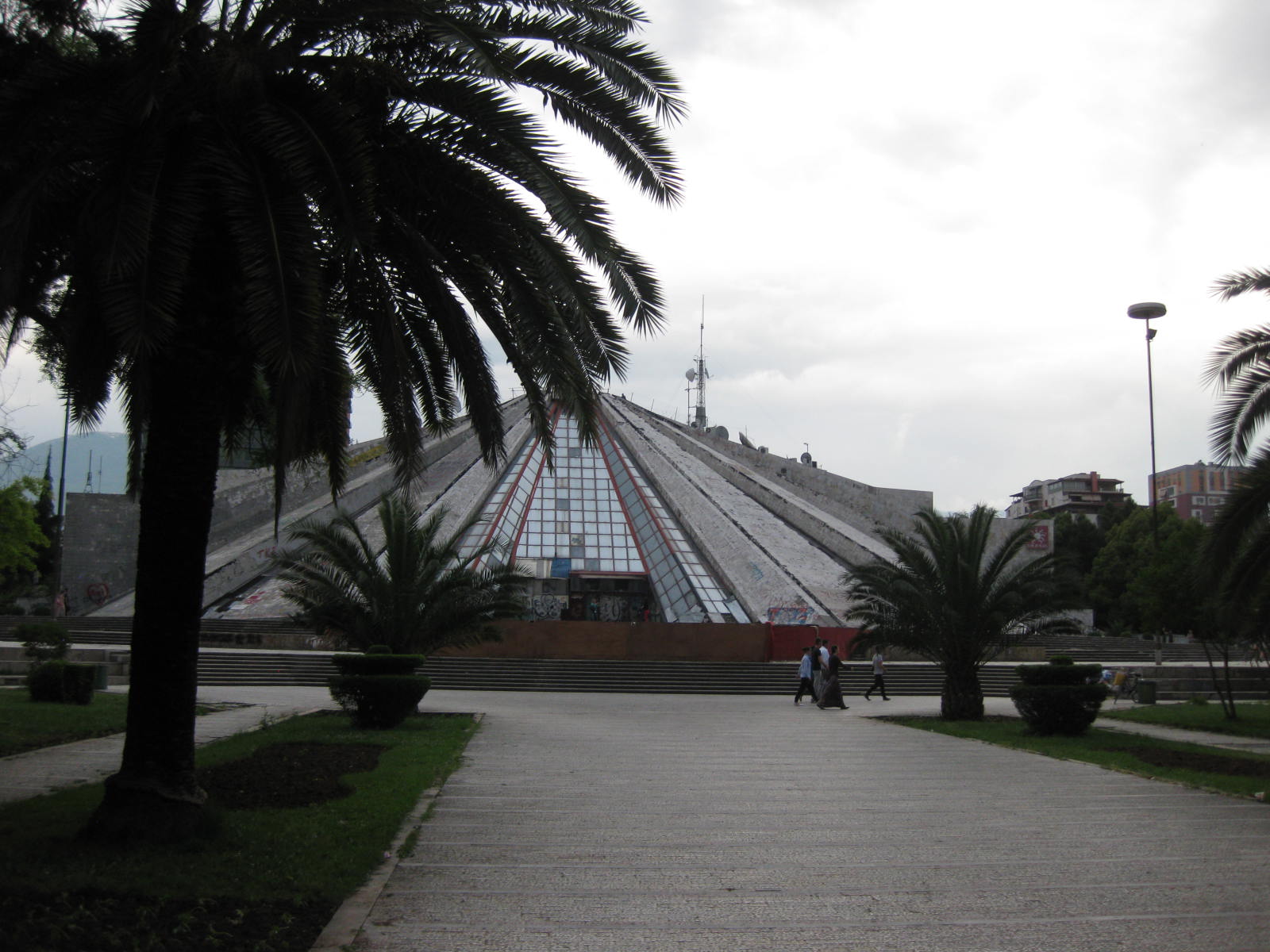
The Pyramid was designed by dictator Enver Hoxha's daughter. Hoxha rules Albania for 40 years until his death in 1985. The Pyramid was briefly a museum dedicated to Hoxha but now is abandoned. Kids climb up the concrete side of the building and slide down. Hoxha founded the Albanian communist party with 6 others in 1941. He was a Stalinist who eliminated every possible rival through trials, executions, and forced labor camps. During his hold on power, Albania was like the today's North Korea.
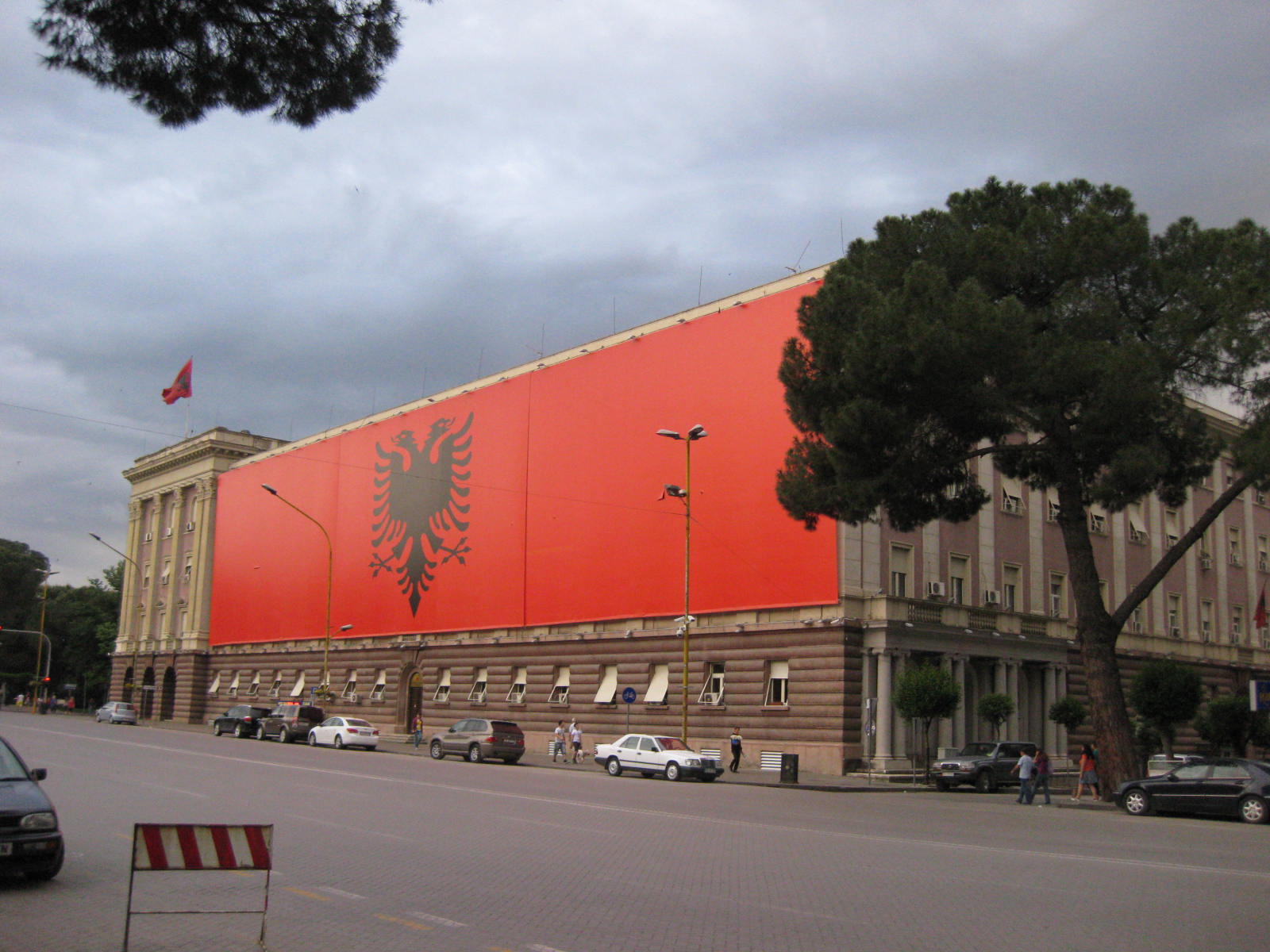
A government building with a huge painted Albanian flag on the exterior. Throughout Albania, Kosovo, and Albanian parts of Montenegro and Macedonia, you can see huge Albanian flags displayed.

Nene Teresa (Mother Teresa) Square and the Polytechnic University. Mother Teresa is certainly the most famous Albanian of the 20th century although she lived in Skopje, Macedonia.

A McDonald's knockoff found throughout the Balkans.

Albania celebrated its 100th anniversary of independence from the Turks in November, 2012, and this painted bunker was installed to acknowledge part of Albania's past. The bunkers are a part of Hoxha's legacy and are concrete domes built throughout the country from 1950 to 1985. They were built to fend off the threat of foreign invaders, and they can resist full tank assaults. The engineer who designed the bunkers had to prove the worth of the structures by standing inside a bunker while it was bombarded by a tank. The communist government claimed that there were approximately 700,000 bunkers installed (one for every four Albanians at that time), but today it is estimated that there were closer to 60,000 bunkers in Albania. The communist regime also built nuclear bunkers under every apartment building. The structures are very difficult to remove, so some are painted and decorated.

As a part of Albania's 100 year independence celebration next to the bunker is a portion of the Berlin Wall seen to the right of the bunker.

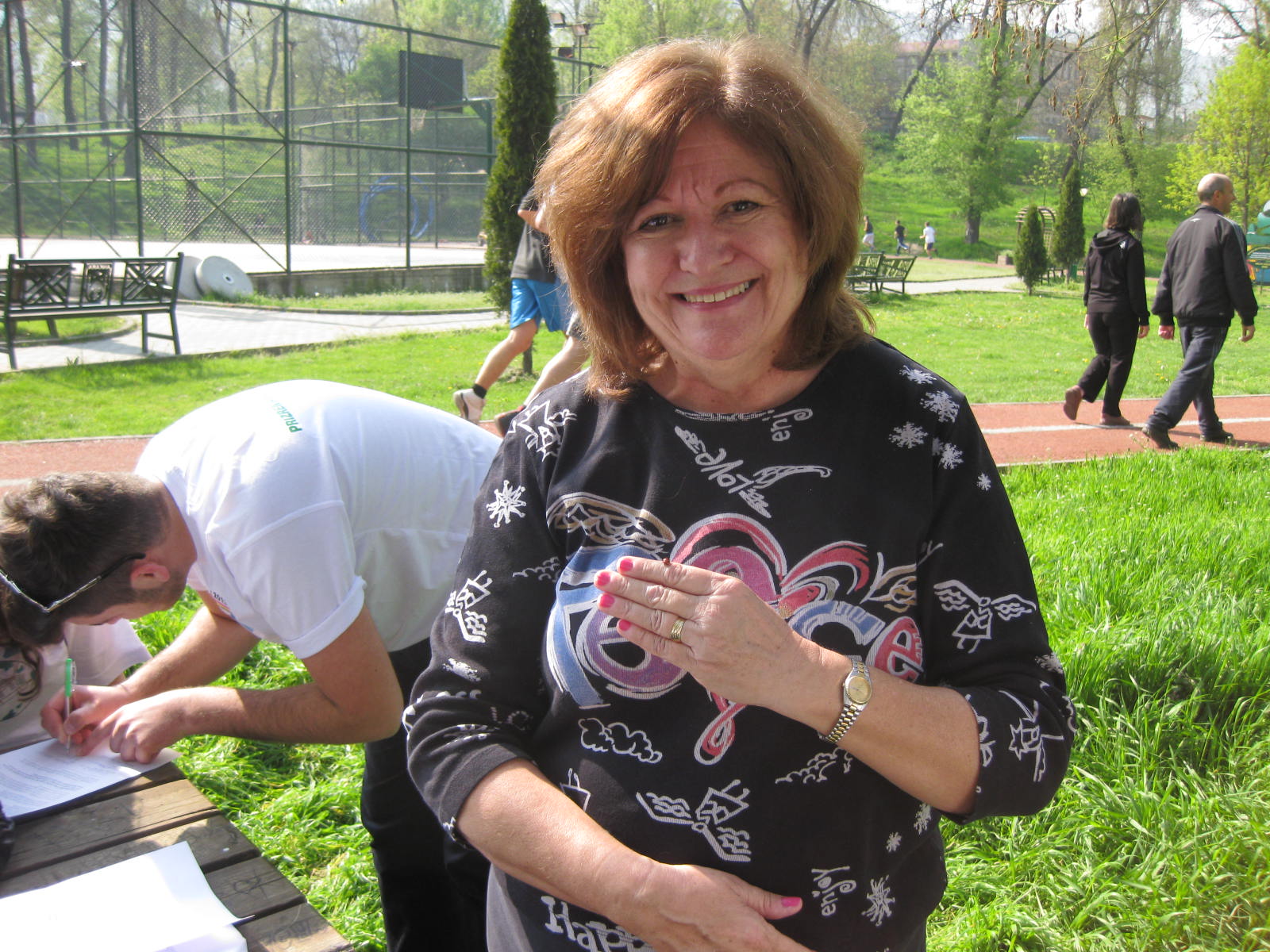
Frank took this photo of me at the ELTA conference after I had presented my two workshops.

While I was presenting, Frank was babysitting 4-year-old Mauricio who is the son of Stephanie, an ELF who is assigned to Pristina. Stephanie is a single mother and expected the conference organizer to arrange a babysitter, but there was no real plan, so Frank graciously offered to take care of Mauricio for about 6 hours. Stephanie and Mauricio have stayed with us in Prizren a couple of times, and we often meet them for lunch or coffee when we are in Pristina. Maurcio doesn't get much male interaction, so he loves being with Frank. Frank took him to a playground and also to an amusement park. They walked all over central Tirana. They also spent some time resting in our room at the pension.

Mauricio at the amusement park.

This is a French patisserie in the district which was formerly reserved for only a few of the communist elite. Today, this area of Tirana is filled with nice cafes, restaurants, and shops.

Mauricio with his mom in the background and an English teacher from Pristina. This was taken at an authentic New York Bagel shop.

The menu at the bagel shop. We haven't had a bagel since leaving Denver 8 months ago, and these were very good!

According to the ELF who lives in Tirana, the bagel shop quietly employs abused women escaping from bad marriages and tries to help them get established. It is very unusual to see a woman working in a restaurant in the southern Balkans.

We went to this lovely restaurant near a beautiful park in Tirana.

The restaurant looked like a castle.

View from our table on an outdoor balcony at the restaurant.

Danielle, the ELF in Tirana. She is originally from Pennsylvania and is an attorney. She teaches legal English to law school students.

Danielle (3rd from left) and I with some English professors from Moldova.

After the conference, the conference planners took the presenters to a traditional Albanian brew pub, Kaon Brewery. This is how they served the beer - in towering carafes with taps for pouring into glasses.

Here it looks like I had a few too many glasses of beer although I only had 2 or 3 over the course of about 3 hours. The restaurant was great. It was in an old industrial part of Tirana and supposedly catered to the factory workers when it first opened. It is a brew pub, but the food is also delicious. We started off with cheeses and homemade bread. Next, we had a beautiful mixed salad. This was followed by what you see here - two kinds of pasta and a creamy chicken breast dish. I was full after this, but we still had the steak, pork chops, and grilled chicken to eat along with more bread and cheese. For dessert, they put huge platters on the table with panna cotta, tres leches, and an assortment of fruit. There was a band playing traditional Albanian music that I really liked. I asked one of the Albanians what kind of music it was because it didn't sound at all like the Albanian music we have to suffer through on bus rides or on many TV stations. I guess the music played in Kosovo and other Balkan countries has more of an Ottoman influence and sounds Mideastern. This music at the brew pub sounded like it had an Italian influence. I tried to get Frank to join us, but he was too pooped after taking care of Mauricio all day. I hope to return to the restaurant next time we're in Tirana. Unfortunately, I didn't have my camera with me, but Danielle took these last 3 photos for me; otherwise you would have seen photos of each dinner course.