Tuesday, May 7, 2013

Skopje

We were in Skopje a couple of weeks ago.  Orthodox Easter was on Sunday, May 5, and it was nice to see Easter decorations in stores since we never see this type of decoration in Kosovo.


More Easter decorations


Frank calls Skopje "Vegas on the Vardar" because there are opulent statues everywhere kind of like you'd see at Caesar's Palace or other locales in Las Vegas.  Frank posted some views of statues after our first trip to Skopje, but the government just keeps adding more and more statues.  After driving in southern Macedonia and other areas, we think the money could be better spent on improving transportation around the country, but those areas aren't where the majority of the population lives.  Above you can see Frank checking out a pedestrian bridge that was being constructed late last year but is now open with 25 statues.


A statue of a swimmer in the Vardar.  Some of the statues are whimsical and fun to look at.  Others just seem too grandiose and overdone.  


This trip we were only in  Skopje about 24 hours, but we saw at least 6 new statues being installed in that short period of time.  They are all in the center of the city.  Above, some workers are unloading a new statue.


I liked these modern statues of shoppers on the main square.


A cowboy-looking statue not far from our hotel.
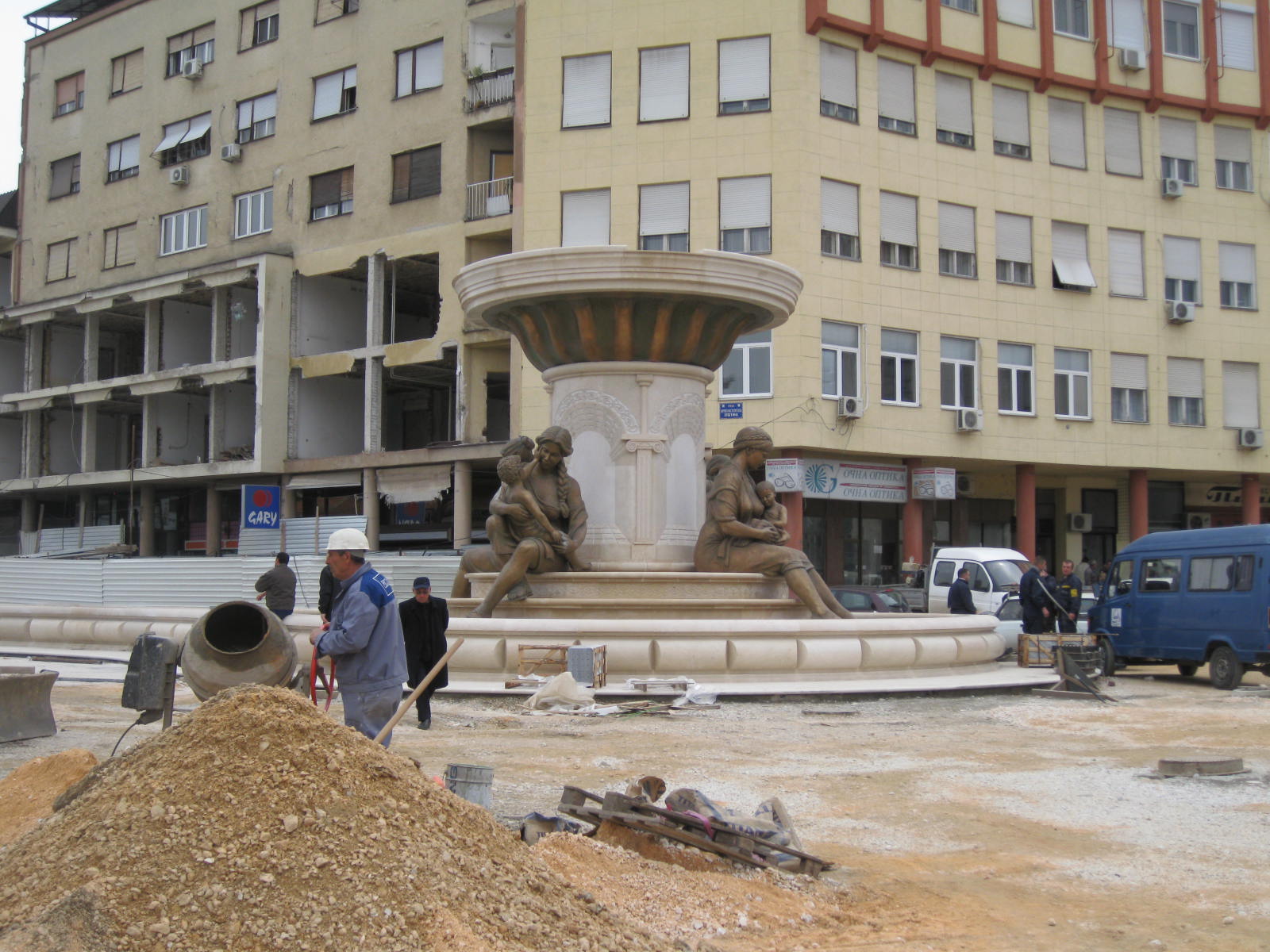


Here's another statue being installed across the river from the main square and near the concert hall and government buildings.


We decided that being a sculptor in Skopje right now would probably be a busy job.


After all of that statue viewing, we needed a macchiato on the big Alexander the Great Square.


This trip we finally walked over to the old Turkish bazaar part of Skopje which is across the river from Alexander the Great Square and most of the statues.  The area is interesting to explore, but the shopping mostly consists of imports from China which I try to avoid.


This was an interesting shop filled with furs - something we don't ever see at least in the Western U.S.  PETA people would be protesting!


Another view of the old bazaar.  Today this area of Skopje is considered to be the Albanian/ Muslim area.


Near the entrance to the old bazaar area, I found our bra man's counterpart - a woman selling ladies' underwear.


A recent photo of the bra man's wares in Prizren.  For those of you who missed the earlier post, this is the entrance to our apartment.  On warm days, in the morning, a guy around 50 sits on a chair and tries to sell the bras.  Frank has even seen him make a couple of sales!  In the afternoons, a guy in his 30s (who seems very shy and may be the original bra man's son) sits inside the building on the first landing as you walk up to our 3rd floor apartment.  His name is Agon, and it seems that he avoids trying to sell the bras.
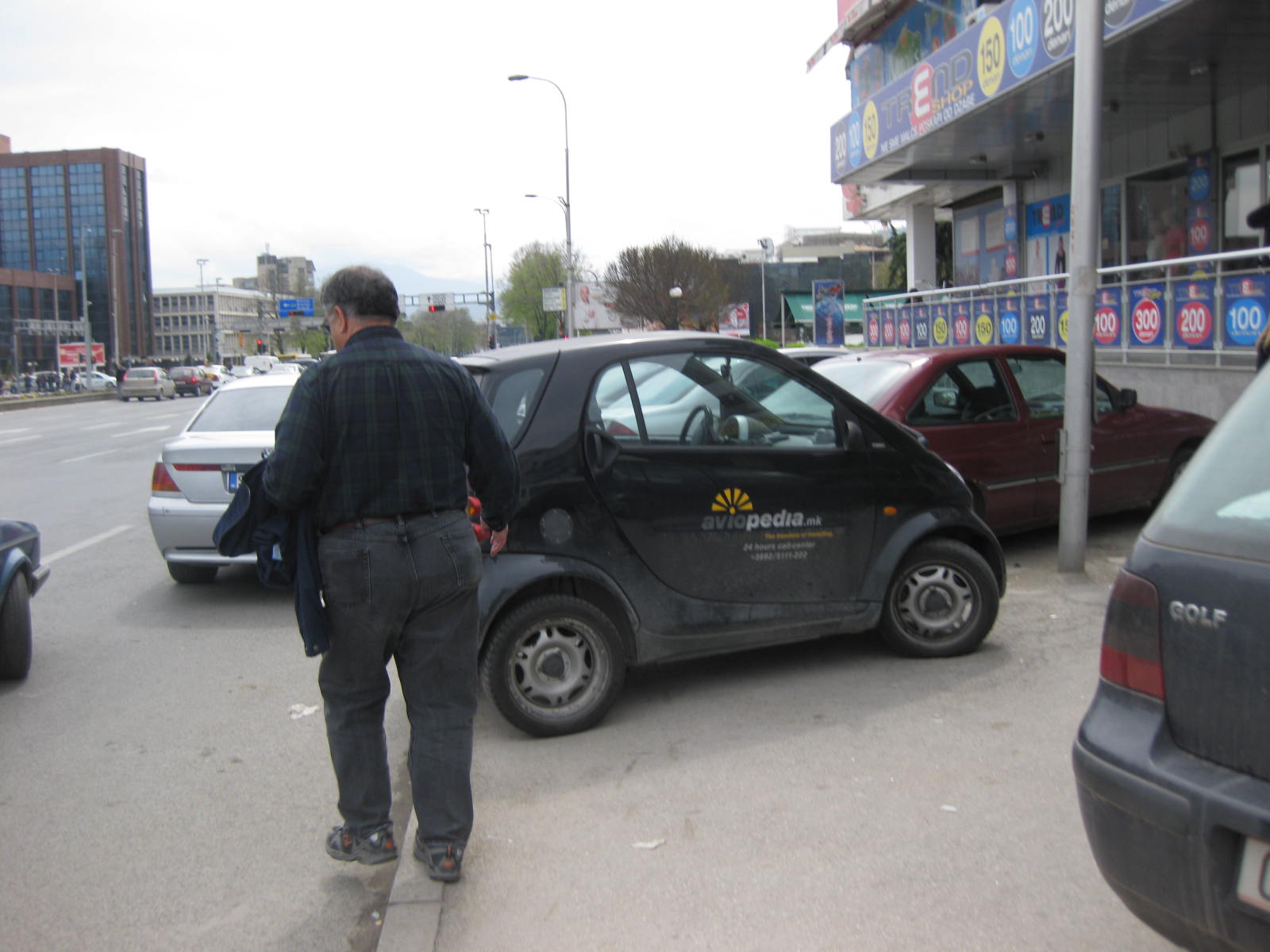


Back to Skopje.  Here is Frank demonstrating the "disappearing sidewalk" which is found throughout the Balkans.  As you can see, cars park at random on the sidewalk, and pedestrians are forced to enter the busy lanes of traffic on the street to get around the parked cars.


I'm leaving you  with a couple of tease photos of our trip to Budva, Montenegro last weekend.  Frank will handle the full report. Here is our first beer and mineral water on the beach.  Frank sampled the local Montenegro brew, Nikisicko; I was still on antiobiotics following my oral surgery, so I couldn't have any alcohol until Sunday.  In the background center, you can see the old walled town of Budva with its church steeple.  We went to Sunday Mass at the church which dates from around the 12th century.


A photo of my toes and the Adriatic from our hotel beach.


Saturday, April 27, 2013

Annette posts more views of Lake Ohrid area and then Skopje, Macedonia again


     Hello again.  I know that Frank and I have been delinquent in providing posts to the blog. We have been preoccupied. Last weekend I didn't get a day off, and this is difficult for me because now I'm used to 4 day weekends since I don't have classes or other work on Fridays or Mondays.  Anyway, last Friday was the American Corner's 7th birthday, and there was a big celebration with library folks from the U.S. in attendance and a full-blown event with entertainment.  On Saturday, I hosted the Earth Day activity that I have been planning with the American Corner students for months.  The activity was great, and we had over 40 volunteers cleaning the local City Park in Prizren.  Sunday, believe it or not, I had to give two make-up final exams.  These were for students who didn't pass the finals in February.  If any of these don't pass again, they will have at least 2 more chances. Photos of these events (minus the final exams) will follow in the next week.

On Monday, we went to Pristina to see my dentist.  I got bad news about the tooth that had a root canal about a month ago.  It still had an infection, so yesterday Frank and I went to Pristina again.  I had surgery on the tooth (including 4 stitches :- (    ) and Frank was in another dentist chair at the same time getting a root canal on a tooth that cracked.  I look like a chipmunk today with my puffy right cheek, but we survived the ordeals and even made plans to go on another UN-sponsored trip next weekend.  This one will be to the beach in Budva, Montenegro.

In this post, I just had to include a few more photos of Lake Ohrid in Macedonia.  I know that Frank already wrote a post on this trip, but we returned to northern Macedonia after our trip to Serbia a couple of weeks ago, and so I though a few more photos of Lake Ohrid and its area would be okay.  I loved Ohrid and hope that we can return but don't know if we'll have the opportunity during this stint in Europe. Anyone who wants to visit a gorgeous area with history to boot and moderate prices should think about visiting Lake Ohrid.


St. Clement Church.  The original church dates from the 5th century but was modified repeatedly over the centuries. In 2002 archaeologist, Pasko Kuzman, oversaw the rebuilding of the church according to its Byzantine design.  In the foreground are Roman ruins, and there is also the foundation of a 4th century church  with well-preserved floor mosaics of flora and fauna. 


Another view of St. Clement and Lake Ohrid.  The mountains in the background form the border between Albania and Macedonia. There is also a national park with hiking.


The old city part of Ohrid is extensive with many narrow alleyways and historic structures (Roman arena, churches, etc.) to explore.


This is a view of Lake Ohrid with the town of Ohrid  across the lake.  The photo was taken from the town of Struga.  This particular day, a storm was moving in, and the waves on the lake were like waves on the ocean.


The previous photo and the next few were taken in the town of Struga which is situated on the north shore of Lake Ohrid.  Here you see the Crn Drim River tumbling out of Lake Ohrid in Struga.


This Crn Drim River is unbelievably clear, and the color is much more turquoise - my camera doesn't do it justice.  


It was a sunny day although a little cool, but Frank and I enjoyed macchiatos on the terrace of this little cafe in Struga.  The lake is in the background.


After leaving Ohrid, we drove through the Macedonian wine country on our way north to Skopje.  We didn't have time to stop at any wineries, and I couldn't drink since I was on antibiotics.  Maybe this summer we can tour some Macedonian wineries.


Now we're skipping ahead a few weeks later. This photo was taken in our car after leaving Serbia and going to Skopje to return the rental car. We knew we were in Macedonia when we saw this restaurant with the multitude of statues.  Frank posted information about the statues in Skopje after our December trip there.  The Macedonians have a thing about statues!


This is our favorite little hotel in Skopje - Hotel Kapistec.  I think it's named after a local soccer team since we saw posters with the same name around town.  It is only around $45 per night including breakfast.  It is centrally located within walking distance of the city center and other sites.   


In developing countries, you can see really creative ways of recycling.  This teenage boy was parked in front of Hotel Kapistec, and he had a cart pulled by a bicycle to carry away recycled materials.


Here you can see the boy pedaling away.


The breakfast room in Hotel Kapistec.  They have a buffet with eggs, bread, yogurt, cereal, pastries, fruit, juices, meat and cheese.  You also can order macchiatos or other coffees.


Seating area in Hotel Kapistec breakfast room.


A view of the Millennium Cross from our hotel balcony.   Supposedly this is the world's largest cross (66 meters high).  It was built in 2002 and is illuminated at night. It is strange seeing such outward signs of Christianity after living for months in a Muslim-dominated country.


Another recycling vehicle in Skopje - this cart is pulled by a moped.


Domino's Pizza in Skopje.....seems like a better way of delivering pizza than the gas-guzzling cars used in the States!

I am signing off for now but will post a few more photos of Skophe later this weekend.  


Tuesday, April 16, 2013

Annette's post about our weekend in Southern Serbia


I just had to add one more photo of driving in the Balkans.  I think this was in Serbia just south of Nis.  It's a guy standing on a horse-drawn cart as he drives.  Also notice the car parked on the sidewalk in front of the store.  (At least there is a little room here for pedestrians.)


A photo taken from the car as we drove into Serbia from Macedonia.  Basically, the view included hilly countryside with mountains in the background and lots of small villages. 


We visited one of my colleagues named Cleyara, a fellow ELF (English Language Fellow) from Texas,  in Nis.  Since she hasn't been able to explore that much outside of the big towns and we had a car, so we told her to pick a place she wanted to visit.  She chose "Devil's Town" which is an area with hoodoo formations like those found in Bryce Canyon, Utah, but on a much smaller scale.  Unfortunately, when we were a couple of miles from the site, we got a flat tire from a nail and this is Frank starting to fix it in the pouring rain. At Devil's Town, I decided to stay in the car and not trek 30 minutes into the muddy, wet hills to view the hoodoos.  Frank and Cleyara braved the weather and had fun exploring.  I will let Frank post some photos about what they saw.  At the site, there were no other tourists, but the guy who sold tickets to the site was there as well as a local who sold raki.  I bought some pear brandy from him.


A local with part of his small herd of cows in Southern Serbia.


A barn in Southern Serbia


Trg Kralja Milana in Nis - the main square in the city center
Nis is the 3rd largest city in Serbia and was founded over 2000 years ago.   It's main claim to fame is that it is the birthplace of Constantine the Great who was born in Nis in 272.  In 312, Constantine became the ruler of the western part of the Roman Empire.  He converted to Christianity after claiming to see a cross in the sky above the sun on which the words "with this sign you will be victorious" appeared. In 324, he became the sole Emperor of Rome. He built a palace near Nis.  


Another view of Trg Kralja Milana with attractive houses built between the late 1800s and early 1900s.  The square is a popular pedestrian area (when it isn't raining!) and also the site of political demonstrations.  The square was named after the King of Milan who was reigning when Nis was freed from Ottoman rule.


Istanbul Gate - the main entrance to the Nis Fortress built by the Turks in the 18th century.


Frank and Cleyara walking through the Istanbul Gate into the fortress which is filled with shops and restaurants.


The Hammam (Turkish baths), now restaurant just inside of the Nis fortress walls.  We tried to eat here, but unfortunately it closed early on Sunday.


Perhaps the most unusual tourist site we have visited is Skull Tower in Nis.  After a bloody battle with Serbian rebels in 1809, the Turkish commander ordered that the killed Serbian insurrectionists should be beheaded, and their heads were skinned and stuffed with cotton and sent to the Sultan.  The remaining skulls were built into a monument as a warning to the rest of the population.


A skull placed in Skull Tower.


A monument and the skull of the Serbian commander, Stevan Sindjelic.


Here you can see the tower which for many years stood outside in the elements.  Relatives of some of those killed took skulls off of the monument and buried them.  A tour guide at the tower told us that in years past, some tourists took skulls as souvenirs!  In 1892, a chapel was built to enclose and protect Skull Tower.  Of the 952 skulls, only 58 remained.  Here you can see many empty spaces where skulls used to be mounted.


View from our hotel suite.  The suite had a balcony, bedroom, bathroom, and living room and was only around $40 a night.


The balcony of our hotel room.


Rainy Serbia.  It rained most of the weekend and on our way back to Skopje, Macedonia.