Friday, November 16, 2012


St. George Serbian Orthodox Church in Prizren.  The church, built in 1887,  is situated right in the city center and about a block from the Catholic cathedral.  On the grounds, there is a seminary where about 20 young men are studying for the priesthood.  After Mass a couple of weeks ago, we were walking by this church, and I told Frank that I wanted to see if we could go inside.  It was a very quiet morning, and we didn't think there was a service.  There are 24 hour guards from the Kosovo government at each of the important Serbian churches in Prizren because in 2004, locals burned Serb churches and homes and ran the Serbian population out of town.  As a part of the establishment of the recognized government, supposedly Serbs are being reintroduced now into Prizren.  We have seen some graffiti regarding this; however, except for seeing some Serbian Orthodox priest walking near this church, we have never seen any evidence of a Serb population.   We approached the guard who was very friendly, and he took us to a young man (a seminarian, I think) who was outside of the church.  It turned out that there was a Mass going on inside, but we were told that we were welcome to attend.  (So Frank got to go to church twice this particular Sunday :-0)  We were surprised that there were 90-100 people attending the service.  Probably at least 60 of these participants were young men and women in their 20s, many of the men being seminarians who were singing during the service.  The inside of the church was obviously recently renovated, and there were no pews or seats...everyone was standing. There were a few small paintings and icons placed on ledges, but obviously, any statues or stained glass windows had been destroyed in 2004.  The Mass was similar to the Catholic Mass, but all in Serbian.  It was interesting to observe.  Late that week, I saw the young seminarian who led us into the church at an outdoor cafe adjacent to the church, and we greet each other.


St. George Serbian Orthodox Church in Prizren.  In the background, you can see another Serbian church on the hill which dates from the 1300s.  This hillside which has the path to the Prizren fortress on the top of the hill, was a Serb neighborhood, but in 2004, the church and dwellings were burned and heavily damaged.  Some of the structures are noticeably abandoned.

Church of St. George or Runovic's church, built from the 14th-16th century and situated right across the street from the large St. George church discussed above.  The tiny church has a single aisle.

Catholic church experiences


This is a photo of Our Lady of Succor Catholic Cathedral in Prizren.  Our cultural awareness of how to act in a Kosovar church has evolved with each passing week.  The first week that we were in Kosovo, we went to a Catholic church in Pristina.  We ended up sitting in the front row because all of the other pews had occupants and we thought that other family members might come to join them.  Unfortunately, I hadn't thought about the fact that we couldn't observe the congregation and how they acted from the front row.  When it came time for communion, I was the only individual on the right side of the church who got up to approach the priest...it turns out that in Pristina, the entire left side of the congregations goes to communion followed by the right side (rather than row by row from each side).  The next Sunday, we were in Prizren, and we went early so that we could get a good seat towards the back in an empty pew. Different church, different town.   Frank and I sat on the right side of the church.  As the pews filled up, we realized that Frank was the only man sitting on the right side of the church.  All of the men were in two different sections on the left side of the center aisle.  Only women and children were on the right side.  It hadn't been like that in Pristina since there were nuns in some of the left pews there.   I have no idea if the men on the left were single or if their wives came in with them and went to sit on the right side of the church. There were a few couples towards the back on the left side. As the weeks have gone by, we have slowly got the hang of where to sit although the language remains a mystery since everything is in Albanian.  At least the Catholic Mass is the same regardless of the location of the church.


Interior of Catholic cathedral built in 1870 in Prizren.  


Interior of cathedral has a painting of Mother Teresa.  Mother Teresa's father, who was an ethnic Albanian, was from Prizren, and her mother was from a nearby village.  Muslims and Christians alike in Kosovo honor Mother Teresa.  The main pedestrian mall in the city center of Pristina is named for her.

Tuesday, November 13, 2012

This is the Iliria Restaurant located in Vermice, Kosovo about 10 miles from Prizren.  It is within a mile or two of the Albanian border. Behin the restaurant is a large man-made lake...the resevoir is dry now, but we will have to visit again early next summer.

Trout served at the restaurant for about $13.  The trout is caught fresh in ponds that surround the restaurant which you can see in a later photo.


A photo of a bottle of Slovenian mineral water for my Bojohn friends back in Colorado,

Fresh water ponds full of trout at the restaurant

Pashtrik Mountain in Vermice....its summit forms the border between Kosovo and Albania.


Frank in fron of the trout ponds at the Iliria restaurant.  We took a cab to and from the restaurant and it ended up costing more than our delicious dinner.  Next time we will figure out the bus schedules from Prizren since there are buses that go regularly to these villages.

Monday, November 12, 2012

I thought I would add a few more photos of Greece to the ones that Frank posted last week.  The above photo is Agios Dimitrios Basilica.  The basement used to be a crypt that became a Roman prixon.  It is where St. Demetrious was matyred by the Romans.  He became the Holy Patron of the city of Thessaloniki.  Some of the parts of the original church that date back to the 5th century (frescoes, pillars, etc.) still exist, but much of the church was rebuilt after a fire in 1917.  The remains of St. Demetrius, once stolen by the Normans in 1185, were returned by the Italian government to the city in 1978 and have a place of honor in the church.


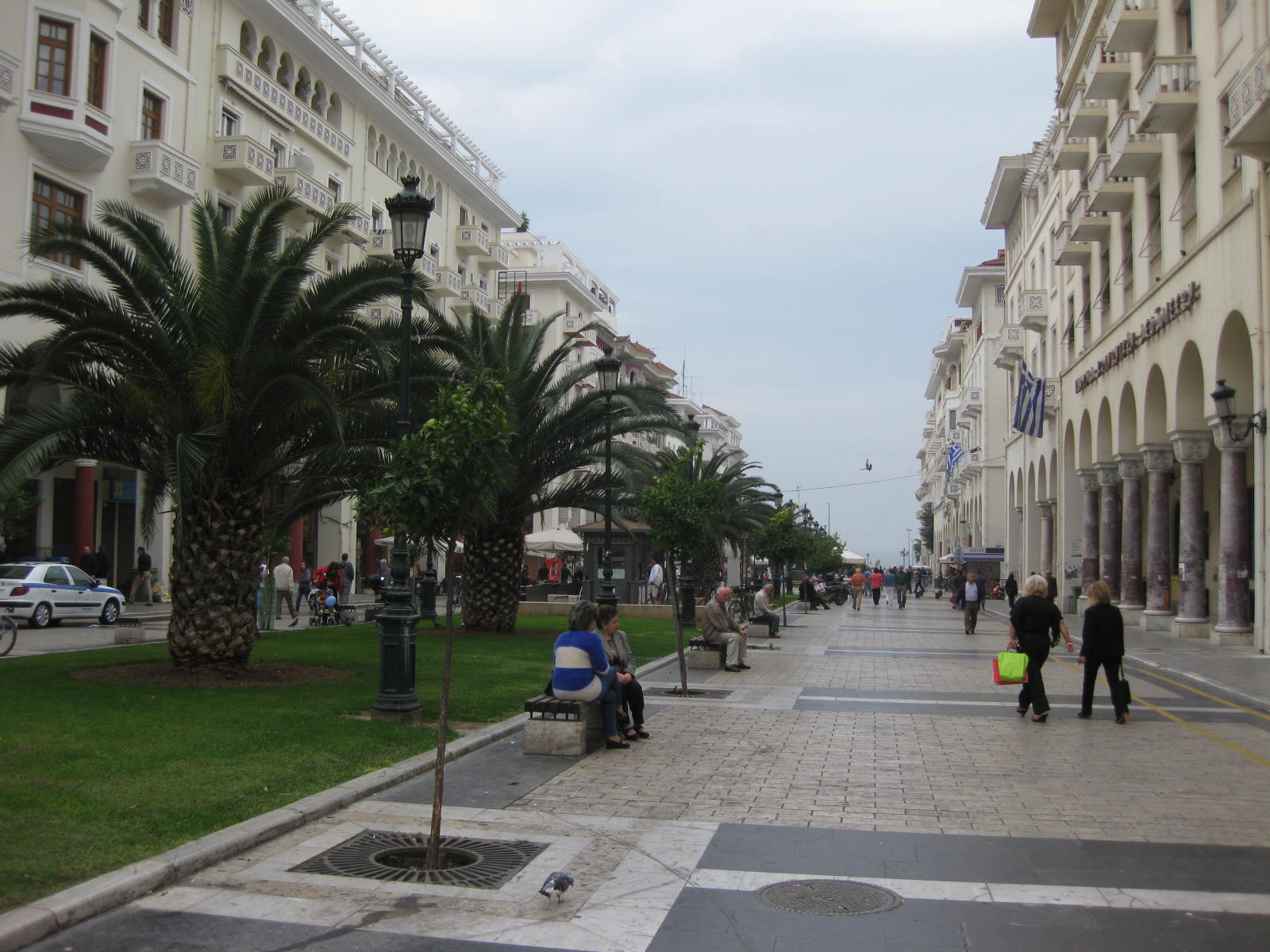
A pedestrian mall near our hotel in Thessaloniki.  The path leads to the Aegean Sea. Thessaloniki was founded in 315 B.C. and named after after Alexander the Great's half-sister.


Another view of the parade held on October 28 to celebrate Thessaloniki's liberation from the Ottomans 100 years ago.


A photo of me in front of The Church of Holy Wisdom - Agia Sophia.  The original church was built in the 4th century immediately after the triumph and establishment of Christianity by the Decree of Mediolanan in 313 and the 1st Ecumenical Synod in 325.  There are mosaics and frescoes dating from the 8th-12th centuries.  Frank and I attended part of a service on the Sunday that we were leaving but couldn't stay for the whole thing since it lasted 2 1/2 hours.


Side view of Agia Sophia

Saturday, November 3, 2012

Here are some photos of our second day in Thessaloniki, Greece -
 
These are the ruins of the palace of Roman Emperor Galerius from the 3rd century AD, which were apparently discovered when digging the foundations of these new apartment buildings.  I can imagine the parents in these apartments telling their kids to go out back and play in the Roman ruins.
This is the White Tower on the waterfront, now the iconic symbol of Thessaloniki.  It was part of the Byzantine wall and fortification around the old city, much of which has now been removed.
A view of the Aegean Sea waterfront, with the White Tower and the city extending off to the east.
 Our first sighting of a Starbucks in Europe.  Annette just had to try it!
A nice view of the Aegean while sipping our venti lattes, which were about 18 ounces larger than the cups of coffee we have gotten used to here in Kosovo.
 
We watched most of the Sunday parade celebrating the 100th anniversary of the surrender of the Turks to the Greek army.  The parade included military units in period uniforms, nurses, mountain rescue teams, firemen and many other service providers.  There were also some Greek Air Force jets buzzing the parade route at very high speeds and very low altitudes.
We were finally able to take the #50 tour bus route after the parade ended.  The bus loops through many of the historic sights and museums in the city.  This photo is from the upper part of the old city and shows a portion of the old protective wall, which is 30' to 40' tall in some places.
One final meal - a mixed grill plate, including the last pork we will see until we leave Kosovo again.
The visit to Thessaloniki was over, time to climb back into the UN bus for the ride back to Prishtina.

Finally have the chance to post a bunch of photos from our Thessaloniki, Greece trip, so here goes -
Annette is happy to start the day - no rain yet but it is coming soon


Our hotel was very close to the old market place, and the seafood looked great.
This is the back side of the Hagia Sofia, an active Greek Orthodox church dating back to the 5th century AD.  The paintings on the inside of the dome are from the 9th century.  We dropped in for a bit of a Sunday service but didn't stay long since it usually lasts 2 1/2 hours.


After skipping out of church we had to eat, so here it is.  Fried calamari for me, eggplant stuffed with feta for Annette, some fries and Greek beer.  Also the menu board where Annette really did say "It's all Greek to me"

Excavation of the Roman Agora ruins started in 1962.  It was built in the 2nd century AD and was the center of the Roman administration of the the region until the 5th century.
 Church of St. Demetrius, originally built in the 4th century AD.  The church was open 24/7 while we were there because they had a priceless painting on display, and so many people were always lined up that we didn't get to see it.
The Rotunda built by Roman Emperor Galerius in the 4th century AD.  Originally built as his mausoleum or a temple.  All of these sites were closed while we were there due to the parades and celebrations going on.  This was the end of our Saturday in Greece.  More to come on the next blog posting.


Friday, November 2, 2012

It was off to Greece for the two of us last weekend.  We went on a UN-sponsored bus trip to Thessaloniki, Greece for a two night stay and had a great time in spite of the constant rain.  We left Prishtina Friday afternoon and the trip took nearly 6 hours, including the time for border crossings into Macedonia and Greece.  After finding our hotel we were hungry, but at nearly midnight we were concerned that we might have trouble finding a place to eat.  However, Thessaloniki lived up to it's reputation as one of the world's top party towns and we had no trouble at all finding a good meal.

The next morning we heard marching band music and saw a parade passing by a couple blocks away from our hotel, and it turns out we were there for a very special weekend.  They were celebrating the 100th anniversary of the Ottoman Empire's surrender of Thessaloniki to the Greek Army, which was just one of the more recent historic events in the history of the town.  Thessaloniki is the second largest city in Greece and was founded in 315 BC and was then the major city in the eastern part of the Roman Empire.  After the fall of the Romans it became the second most important city in the Byzantine Empire, then the Ottomans captured it in 1430.  Needless to say, lots of history and too many interesting sites to see on a weekend trip.  But, we did our best in spite of the fact that some city buses were shut down due to the parades and many historic sites were also closed all weekend.  Our trip back on the UN bus went a little faster since the border crossings went a lot faster and we got back to Prishtina by 7:30 PM.  That would normally be early enough to catch a 4 euro bus back to Prizren, but since Kosovo was still celebrating the Muslim Eid holiday the buses weren't running, so we did a 50 euro taxi ride back home instead. 

We were tired after the trip so this blog posting had to be delayed a bit. Annette's teaching load keeps getting harder as more and more students come to her classes.  She now has over 40 in each class and more seem to come every day even though it is the 5th week of the semester.  We also had a lot of planning and running around to get ready for the Halloween party at the American Corner.  As the resident Americans we were getting the candy and other stuff for the party, so it was a very busy and tiring week.  But, it was fun and the kids seemed to have a lot of fun.  I even enjoyed it, and I don't even like Halloween!  We are off to dinner and a play in a few minutes.  We will post lots of photos of Thessaloniki soon.